
Mining insurance is a specialized form of insurance designed to address the unique risks associated with the mining industry and to protect miners' operations, assets, and reputation.
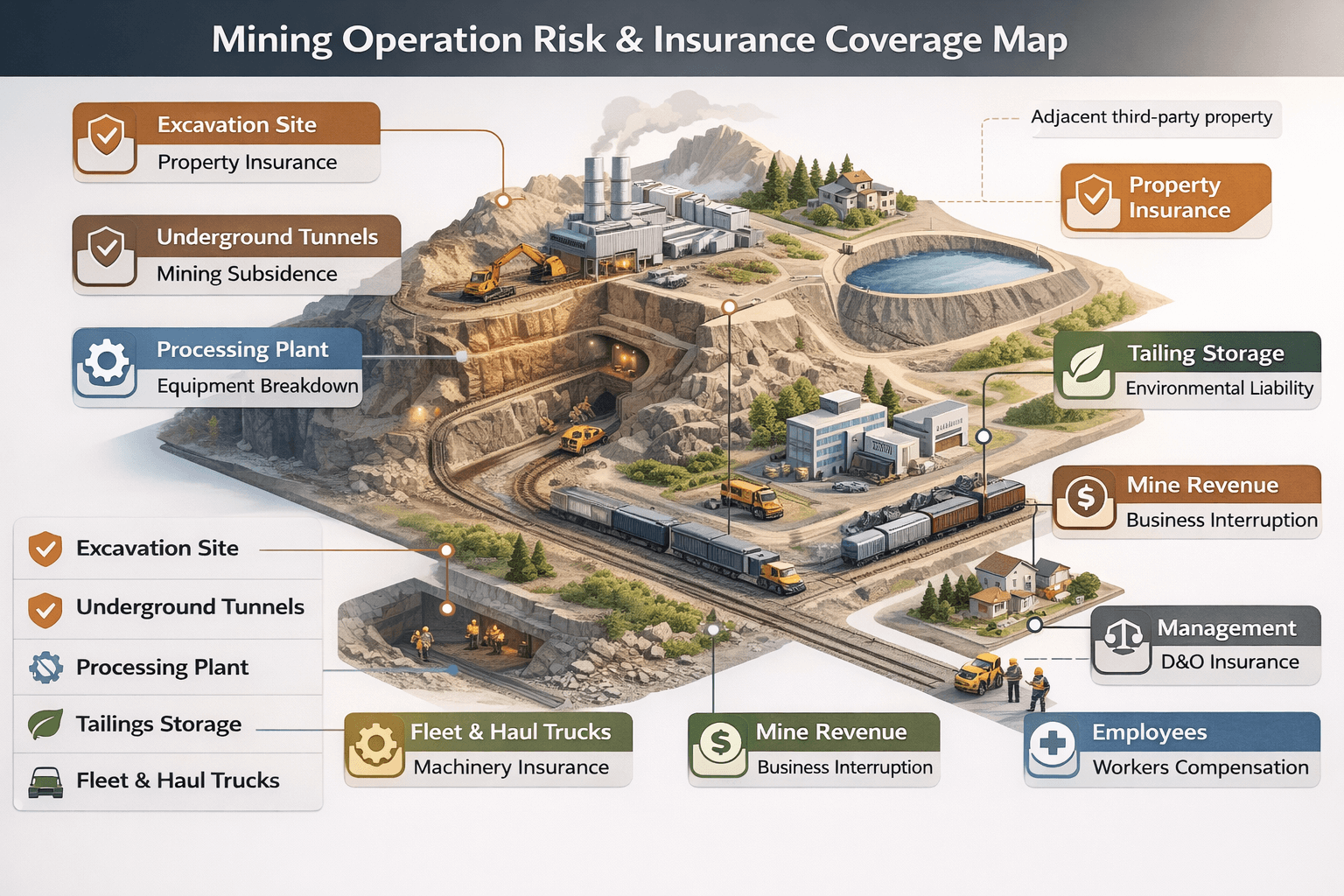
- It covers a wide range of potential losses, including property damage, equipment breakdowns, cyber attacks, environmental liabilities, and employee injuries.
- By providing financial protection against unforeseen events, mining insurance enables companies to continue their operations even in the face of disasters.
Last updated: September 23, 2026
Get Mining Insurance Tailored to your Goals
Lowest cost is contractually guaranteed for similar protection that is tailored to your goals, otherwise we pay the difference. Applicable worldwide.
👉 Our independent insurance engineers typically save clients 10–35% on mining insurance while eliminating coverage gaps that could cost far more later. Our team also provides Full Claims Management with Cash Advance at Loss (a Broker is not technically involved in claims, unlike an insurance claims consultant).
🔍 Want expert guidance on Mining Insurance? Contact DeshCap today to ensure you’re fully protected and optimizing costs!
Why Generalist Industrial Expertise Isn't the Same as Mining Expertise
Mining insurance is frequently placed by brokers whose actual expertise is generalist industrial or property risk, relabeled as mining experience because the policy covers heavy equipment and physical assets that look similar to other industrial risks on paper. The gap this creates shows up specifically around environmental liability: standard pollution exclusions, written for conventional industrial contamination scenarios, often don't map cleanly onto progressive, long-tail contamination risk from tailings storage or mine drainage — exactly the scenario most likely to produce a major mining claim.
Underwriting capacity for coal and hard-rock mining has also contracted meaningfully in recent years as insurers reassess appetite for the sector, which means market access to the underwriters who still actively write mining risk — not broker size alone — increasingly determines whether a company gets competitive terms at all. Financial assurance and reclamation bonding requirements add a further layer most generalist industrial brokers don't handle as a matter of course.
An independent review confirms your environmental liability wording actually responds to progressive contamination scenarios, and that your programme reflects current, not legacy, market capacity for the sector.
Get Your Mining Insurance Programme Reviewed — $250
A Comprehensive Overview of Mining Insurance
Mining is one of the most critical and high-risk industries globally. From exploration and extraction to construction and production, each stage of mining is accompanied by significant risks, ranging from environmental damage to equipment breakdowns and workforce safety hazards.
Types of Mining Insurance Coverage
• Property
• Liability
• Equipment Breakdown
• Business Interruption
• Environmental Impairment
• Workers Compensation
The Cost/Benefit of Mining Insurance
The cost of mining insurance varies depending on the size of the operation, location, and specific risks involved. However, the benefits of having comprehensive mining insurance far outweigh the costs in most instances. Here’s why:
1. Financial Protection
Mining insurance provides financial protection against unexpected losses. Whether it’s a natural disaster, equipment breakdown, or legal claim, insurance coverage ensures that the company can recover without significant financial strain.
2. Business Continuity
Mining operations are often capital-intensive, and any disruption can lead to substantial losses. Insurance coverage minimizes downtime by covering repair and replacement costs, allowing operations to resume quickly.
3. Compliance and Regulatory Protection
In many countries, mining companies are required by law to have certain types of insurance, such as environmental liability or workers’ compensation. Having the right insurance coverage ensures compliance with local regulations, reducing the risk of fines or legal issues.
4. Investor Confidence
Mining insurance enhances investor confidence by demonstrating that the company has taken steps to mitigate potential risks. Investors are more likely to support businesses that are well-prepared for unforeseen challenges, leading to better financing and growth opportunities.
5. Reputation Management
A major accident or environmental disaster can damage a company’s reputation. Insurance coverage helps manage these risks by providing resources for damage control, legal defense, and compensation, preserving the company’s image in the eyes of stakeholders.
6. Long-term Savings
While mining insurance comes at a cost, it often results in long-term savings. By mitigating the financial impact of accidents, equipment failures, and legal claims, insurance prevents large, unexpected expenses that could otherwise jeopardize the company’s future.
Key Risks Covered by Mining Insurance
1. Property Damage and Theft
Mining operations often involve expensive equipment and infrastructure that are susceptible to damage due to natural disasters, accidents, or theft. Insurance policies covering property damage ensure that the company can replace or repair damaged assets, minimizing operational downtime. Learn more about commercial property insurance.
2. Equipment Breakdown
Mining machinery is subject to wear and tear, breakdowns, and malfunctions. Equipment insurance provides coverage for repair or replacement, ensuring that production does not suffer due to equipment failure. Learn more about underground mining equipment insurance below.
3. Environmental Liability
Mining activities can cause significant environmental impacts, such as soil degradation, water contamination, and air pollution. Environmental liability insurance protects companies from legal and regulatory actions stemming from environmental damage.
4. Workforce Injuries and Safety
The mining industry poses significant hazards to workers, including accidents, falls, and exposure to hazardous materials. Workers’ compensation insurance covers medical expenses, lost wages, and legal costs if employees are injured on the job.
5. Political and Geopolitical Risks
In some regions, mining companies face risks due to political instability, regulatory changes, and even expropriation of assets. Political risk insurance provides coverage against these uncertainties, allowing companies to operate in volatile regions with more confidence.
6. Other conventional and crypto mining operational risks
Choosing the Right Mining Insurance
When selecting mining insurance, it’s essential to work with independent insurance experts that understand the unique risks and challenges of the mining industry. Some factors to consider include:
- Location of Operations: Mining companies operating in remote or politically unstable regions may need additional coverage for political risks, supply chain disruptions, and natural disasters.
- Type of Mining: The risks associated with coal mining differ from those in gold or mineral mining, so tailor your policy to the specific type of operation.
- Environmental Impact: Companies with significant environmental exposure should prioritize environmental liability insurance to protect against legal claims and regulatory fines.
- Size and Scope of Operations: Larger operations may require more comprehensive coverage to protect a wide range of assets, equipment, and personnel.
Mining Contractor Insurance: Comprehensive Coverage
Mining Contractor Insurance is a specialized coverage designed to protect contractors, subcontractors, and service providers working in the mining industry from a wide range of risks, including equipment damage, worker injuries, environmental liabilities, and contractual disputes. Given the high-risk nature of mining operations—whether in open-pit, underground, or mineral extraction projects—contractors face significant liability, operational, and regulatory risks that can lead to severe financial losses if not properly insured.
Essential coverages in mining contractor insurance include General Liability Insurance, Workers’ Compensation, Commercial Auto Insurance, Equipment & Property Insurance, Pollution Liability, and Professional Indemnity Insurance for consultants and engineers.
Companies procuring mining contractor insurance should prioritize comprehensive policy audits to ensure coverage aligns with industry regulations, OSHA standards, and environmental compliance laws.
Independent insurance consultants can help audit, structure, and negotiate policies to prevent hidden exclusions, reduce costs, and maximize claims success. By securing a tailored mining contractor insurance policy, businesses can enhance operational resilience, financial protection, and compliance assurance, ensuring long-term success in the mining sector.
Underground Mining Equipment Insurance
Underground Mining Equipment Insurance provides specialized protection for heavy-duty machinery operating below the surface, safeguarding businesses against costly repair bills, property damage, and unexpected interruptions.
This coverage typically includes protection for critical components such as drilling rigs, loaders, and continuous miners, ensuring companies can maintain productivity even in high-risk environments.
Additionally, a robust underground mining equipment policy can encompass liability coverage, environmental pollution clauses, and mechanical breakdown insurance, offering comprehensive risk management tailored to the unique challenges of mining operations.
By working with experienced independent insurance consultants such as our team, companies can customize policies that address specific hazards—such as cave-ins or equipment malfunctions—while also complying with regulatory requirements. Investing in the right underground mining equipment insurance policy not only mitigates financial exposure but also demonstrates a commitment to operational safety and long-term success.
👉 Contact us or get tailored coverage instantly.
About Mining Indemnity Insurance
It is a form of professional indemnity insurance that is crucial for protecting companies against third-party claims arising from incidents related to their mining operations.
This type of insurance provides compensation for claims of negligence, property damage, or injury caused by mining activities. It covers legal costs and settlements, reducing the financial burden on the company.
Explaining Mining Industry Insurance
Mining industry insurance is a broad term that encompasses various policies tailored to meet the unique risks faced by mining companies.
It includes coverage for property, equipment, environmental liabilities, and worker safety. With the complexity of mining operations, a comprehensive insurance package ensures that all aspects of the business are protected, leading to better business performance and resilience. Learn more about comprehensive risk protection for the industry as a whole, below.
The Importance of Mining Insurance
As tech-based advisors independent of brokers or insurance lobbyists, we specialize in changing and triggering the language of mining insurance, negotiating with insurance brokers, and triggering the insurance at loss. We can also contractually guarantee the lowest cost of mining insurance.
The mining industry is prone to numerous risks that can halt operations, cause financial losses, or damage a company's reputation. These risks include accidents, equipment failures, environmental liabilities, and political instability.
Without proper insurance coverage, mining companies are exposed to significant financial burdens, which can lead to operational disruptions or even bankruptcy.
Having the right mining insurance allows companies to manage these risks effectively. It ensures business continuity, protects against a faulty insurance claiming process, and provides peace of mind to stakeholders, including investors and employees.
An Overview of Mining Subsidence Insurance
Mining subsidence insurance protects against structural damage caused by ground movement resulting from underground mining operations. Subsidence can occur years after excavation and may impact buildings, infrastructure, pipelines, rail systems, and nearby commercial property.
Mining subsidence risk is particularly relevant in regions with historical underground extraction activity, where void collapse, soil displacement, or ground instability can cause:
- Structural cracking
- Foundation failure
- Roadway deformation
- Utility line rupture
- Property value impairment
Standard property or mining insurance policies may exclude subsidence unless specifically endorsed. In many cases, coverage must be structured through specialized extensions or standalone subsidence insurance programs.
Organizations operating in former or active underground mining regions should assess subsidence exposure through a technical risk audit before binding coverage.
Insurers evaluate:
- Geological surveys
- Depth and type of excavation
- Historical mine mapping
- Soil composition
- Proximity to third-party structures
- Monitoring and stabilization controls
Premium pricing depends on asset value, loss history, and engineering controls in place.
For mine operators and real estate developers, subsidence exposure can create significant liability and long-term claims complexity. Independent review of policy wording ensures that subsidence triggers, exclusions, and aggregation provisions do not undermine recovery at loss.
👉 Contact us or get tailored coverage instantly.
Mine Subsidence Insurance Cost
Mine subsidence insurance cost varies depending on geological exposure, asset value, historical mining activity, and structural vulnerability. Premiums are typically influenced by:
- Depth and type of underground mining
- Soil composition and collapse probability
- Property construction type
- Distance from abandoned shafts
- Historical claims data
- Engineering stabilization controls
For commercial properties near former mining regions, mine subsidence insurance cost may range from a modest endorsement fee to a specialized standalone premium where exposure is elevated.
In higher-risk areas, insurers may impose sub-limits, waiting periods, or structural inspection requirements before binding coverage. Independent review of policy wording is essential to ensure that subsidence triggers are not narrowly defined in a way that restricts payout.
👉 Contact us or get tailored coverage instantly: the lowest mining subsidence insurance cost is contractually guaranteed, otherwise we pay the difference.
Mine Subsidence Insurance Illinois
Mine subsidence insurance in Illinois is particularly relevant due to the state’s history of underground coal mining. Certain regions in Southern and Central Illinois have elevated subsidence exposure resulting from legacy extraction activity.
Illinois property owners may obtain mine subsidence insurance either through:
- State-backed programs where available
- Endorsements to property insurance policies
- Specialized commercial placements for higher-value assets
Commercial mining operations and real estate developers in Illinois should assess:
- Historical mine mapping records
- Proximity to known voids
- Structural engineering reports
- Potential third-party liability exposure
Because Illinois has specific geological and regulatory characteristics, underwriting evaluation differs from other jurisdictions. Mining operators and property owners benefit from aligning subsidence insurance with broader property, environmental, and business interruption coverages to avoid coverage fragmentation.
👉 Contact us or get tailored coverage instantly.
Mine Subsidence Insurance Indiana
Mine subsidence insurance in Indiana is particularly relevant due to the state’s historical underground coal mining activity. Certain regions in southwestern Indiana have documented subsidence exposure resulting from abandoned shafts and void collapse.
Property owners and mining operators in Indiana may face structural damage risks including:
- Foundation cracking
- Surface collapse
- Infrastructure deformation
- Utility line disruption
Mine subsidence insurance in Indiana may be available through state-backed mechanisms or private market endorsements, depending on property type and exposure profile. Insurers typically review geological surveys, mine mapping records, and soil stability data before underwriting coverage.
Because subsidence exclusions are common in standard property policies, Indiana-based mining operations and adjacent commercial properties should confirm that subsidence triggers are explicitly included within policy wording.
👉 Contact us or get tailored coverage instantly.
Mine Subsidence Insurance in All Other States and Countries
Mine subsidence insurance is not limited to historically coal-producing states such as Illinois and Indiana. Subsidence exposure exists in multiple jurisdictions across the United States and internationally wherever underground extraction activity has occurred.
In the United States, states such as Pennsylvania, West Virginia, Kentucky, Ohio, and parts of Virginia have documented subsidence risk linked to historical coal mining. In western states, subsidence exposure may arise from abandoned metal or mineral shafts.
Internationally, subsidence exposure is relevant in:
- United Kingdom (historic coal mining regions)
- Australia (New South Wales and Queensland)
- Canada (Nova Scotia and select mining provinces)
- South Africa (gold mining regions)
- Eastern Europe (legacy underground extraction zones)
Availability and structure of mine subsidence insurance vary significantly by jurisdiction. In some regions, subsidence coverage may be available through:
- State-backed insurance mechanisms
- Government compensation schemes
- Endorsements to property insurance
- Specialized standalone subsidence policies
In other jurisdictions, subsidence may be excluded under standard property forms unless specifically endorsed.
Insurers typically evaluate:
- Historical mine mapping records
- Depth and method of extraction
- Soil and geological stability
- Distance from abandoned shafts
- Structural engineering assessments
Because subsidence risk can materialize decades after mining activity ceases, property owners, developers, and lenders in former mining regions should assess exposure proactively rather than assuming standard property coverage applies.
Independent review of subsidence wording ensures that collapse triggers, waiting periods, aggregation clauses, and exclusion carve-outs do not materially restrict recovery.
👉 Contact us or get tailored coverage instantly.
More on Insurance for the Mining Industry for Comprehensive Risk Protection for Mining Operations
Insurance for the Mining Industry is a specialized coverage designed to protect mining companies, contractors, and suppliers from the unique risks associated with exploration, extraction, processing, and transportation of minerals.
Given the hazardous nature of mining operations—ranging from equipment failures, site accidents, and regulatory fines to environmental liabilities, supply chain disruptions, and political risks—having a tailored insurance policy is essential for financial stability and operational resilience.
Key coverages in mining industry insurance include General Liability Insurance, Environmental Liability Insurance, Workers’ Compensation, Business Interruption Insurance, Equipment Breakdown Insurance, and Political Risk Insurance for operations in volatile regions.
Mining companies should work with independent insurance consultants to audit policy language, ensure compliance with industry regulations (e.g., OSHA, MSHA, ISO 14001), and negotiate the best coverage terms with insurers.
Businesses looking to procure mining insurance should focus on comprehensive risk management strategies to protect assets, workers, and investments while ensuring maximum claim success and cost optimization. By securing the right insurance for the mining industry, companies can enhance operational resilience, minimize financial exposure, and safeguard long-term profitability in an increasingly unpredictable global mining landscape.
Learn more about the latest trends on mining operations from resources published by the likes of the National Mining Association.
Gold Mining Insurance
Gold mining insurance addresses the unique operational, environmental, and financial exposures associated with gold extraction and processing. Compared to other mineral operations, gold mining may involve:
- Remote site operations
- High-value inventory risk
- Political and regulatory exposure
- Environmental contamination risk
- Transportation of precious metals
Gold mining insurance programs often combine:
- Property and equipment coverage
- Business interruption protection
- Environmental liability
- Crime and fidelity insurance
- Political risk insurance (where applicable)
Because gold inventory can represent significant mobile value, security and transit exposures materially impact underwriting. In certain jurisdictions, additional risk factors such as government royalties or geopolitical instability may affect pricing and coverage availability.
Proper structuring of gold mining insurance ensures that both operational assets and extracted product value are protected against catastrophic loss scenarios.
👉 Contact us or get tailored coverage instantly.
Process Mining Insurance
- Process mining involves using technology and data analysis to optimize mining operations.
- Process mining insurance covers risks associated with technological failures, data breaches, and intellectual property theft.
- As mining companies increasingly rely on digital tools to enhance productivity, process mining insurance protects these technological investments.
Mining Mineral Rights Insurance
Mining mineral rights insurance protects landowners, investors, and operators against legal and financial risks arising from ownership disputes, lease conflicts, royalty disagreements, and subsurface access rights.
In jurisdictions where surface rights and mineral rights are separated, disputes over extraction authority, environmental obligations, and third-party access can lead to costly litigation.
Mining mineral rights insurance may address:
- Title defects or competing ownership claims
- Royalty payment disputes
- Lease termination conflicts
- Access and easement challenges
- Environmental liabilities tied to historical extraction
- Regulatory non-compliance exposure
For institutional investors and private equity groups acquiring mining assets, mineral rights insurance can support due diligence and protect long-term revenue streams. Because mineral rights structures vary significantly across jurisdictions, policy wording must align with local property law and extraction regulations.
Independent review of exclusions and trigger language is essential to ensure coverage responds to real loss scenarios rather than being limited to narrow title defects.
👉 Contact us or get tailored coverage instantly.
Mine Workers Insurance and Employer Liability
Mine workers insurance protects mining companies against employee injury, occupational disease, and employer liability claims arising from hazardous work environments. Mining operations—particularly underground and heavy equipment sites—carry elevated exposure to:
- Equipment-related injury
- Collapse or subsidence incidents
- Respiratory disease claims
- Chemical exposure
- Long-term occupational illness
Mine workers insurance typically includes:
- Workers’ compensation coverage
- Employer’s liability protection
- Occupational disease endorsements
- Defense and legal costs
Because mining injuries can involve severe claims and regulatory investigations, the structure of employer liability wording and policy limits materially affects financial exposure. In many cases, insurers assess safety protocols, training programs, and historical incident rates when determining mine workers insurance premiums.
Aligning workers’ coverage with broader mining liability and property insurance reduces coverage fragmentation in catastrophic events.
👉 Contact us or get tailored coverage instantly.
Mining Insurance Broker
It is important to hire the right mining insurance broker who is able to negotiate with insurers on tailored coverage terms that are set by independent mining insurance experts.
Contact us to hire a mining insurance broker today or learn more about conducting an rfp in insurance for best selection of a mining insurance broker.
Mining Insurance Companies in Canada
Canada is home to some of the largest mining operations in the world, and mining insurance companies in Canada provide tailored solutions for the sector.
These insurers offer a range of policies, including coverage for property damage, environmental liabilities, and equipment breakdowns.
Canadian mining companies benefit from specialized insurance products that address the unique risks associated with operating in diverse and often challenging environments.
Mining Professional Indemnity Insurance in Australia
Mining professional indemnity insurance in Australia provides coverage for professionals involved in the mining industry, such as engineers, geologists, and project managers.
This type of insurance protects professionals from claims of negligence, errors or omissions in their work. It ensures that mining professionals can carry out their duties without the fear of legal repercussions, promoting better decision-making and performance.
What is Bitcoin Mining Insurance
Bitcoin mining, though different from traditional mining, also carries significant risks. Bitcoin mining insurance is a sub-category of Crypto Mining Insurance and includes coverage for risks such as equipment failure and cyber-attacks including data breaches, which can be protected uniquely through data breach insurance.
As the cryptocurrency market continues to grow, Bitcoin mining insurance becomes increasingly important for safeguarding digital assets and mining operations from both physical and virtual threats. Also refer to crypto exchange insurance for companies acting as brokers, investors, or custodians of digital assets.
Mining Construction Insurance
Mining construction insurance provides coverage during the development and construction phase of mining projects. It includes coverage for construction equipment, contractor liabilities, and environmental risks. This type of insurance ensures that projects are completed on time and within budget by protecting against unforeseen construction-related risks. This also includes elements of Surety Bond Financing as well as Builders Risk Insurance.
Mineral Insurance
Mineral insurance provides coverage for companies engaged in the extraction of various minerals, including coal, copper, and iron. It protects against risks such as property damage, equipment failures, and environmental hazards. Mineral insurance ensures that companies can continue their operations despite the inherent challenges of the mining industry.
Connecting Miner Insurance to Mining Risk Management
Mining is a high-risk industry, and the importance of having comprehensive mining insurance cannot be overstated. From equipment breakdowns and property damage to environmental liabilities and workforce safety, mining insurance provides essential protection that ensures business continuity and financial stability.
Whether you're involved in gold mining, construction, or even Bitcoin mining, having the right insurance coverage is crucial for managing the unique risks that come with the industry. By working with specialized insurers and considering the advice of risk experts, mining companies can safeguard their future and achieve long-term success.
Investing in mining insurance is not just about compliance; it's a strategic decision that offers peace of mind, enhances investor confidence, and protects valuable assets from unforeseen events. Learn about Mining Safety.
Frequently Asked Questions
Q: What is mining insurance?
A: Mining insurance is a suite of coverage designed to protect mining operations from physical damage, liability, environmental contamination, workers’ compensation exposure, and revenue interruption tied to mine closures. It typically includes property, liability, equipment breakdown, and business interruption coverages.
Q: How much does mining insurance cost?
A: Mining insurance cost varies widely based on mine type, location, asset value, and loss history. Typical property insurance may range from 0.2% to 1% of asset value, while liability and interruption coverages depend on operational exposure.
Q: Does mining insurance cover environmental contamination?
A: Yes, many mining insurance programs include or can be endorsed with environmental impairment liability to cover cleanup costs, fines, and third-party claims where permitted by law.
Q: Is business interruption insurance part of mining coverage?
A: Yes, business interruption (or mine shutdown) insurance compensates for lost revenue when operations halt due to a covered physical loss or property damage.
Q: How do insurers assess mining risk?
A: Insurers assess geological conditions, equipment quality, workforce training, safety controls, regulatory compliance, and historical loss experience to determine mining risk and pricing.